|
(Para ver la versión en español visite aquí).
Dear Neighbors,
There are dates we mark on a calendar, and there are dates the calendar can barely contain.
September 11 belongs to the latter.
Twenty-five years have passed since a clear Tuesday morning became one of the darkest days in our nation’s history. A generation has grown up knowing the attacks largely through photographs, classrooms, and the stories we have handed down. Yet for millions of us, September 11, 2001, does not feel entirely like history. We remember the blue of the sky before the smoke. The terrible uncertainty. The photographs of missing loved ones appearing across our city. The families waiting for a telephone call that would never come.
Nearly 3,000 lives were taken that day. Behind that number were names, families, unfinished conversations, ordinary mornings that never reached evening. And the grief did not end when the smoke cleared. Families carried an absence that could not be placed neatly into the past, while survivors and first responders carried wounds, visible and invisible, that would follow them for years and decades.
September 11 also cast a longer shadow across our nation and the world—through war, the erosion of civil liberties, surveillance, torture, and a politics of fear whose consequences remain with us.
I carry those memories as a New Yorker, as a public servant, and as a Muslim.
In 2001, the year our city was attacked, New Yorkers elected me to represent the 7th District in the New York City Council, where I would serve as the first and only Muslim member during my tenure. Seventeen years later, I also became the first Muslim elected to the New York State Senate.
I have never taken lightly what that journey represents. In the aftermath of 9/11, too many Muslim New Yorkers were made to feel that their faith rendered them suspect. We watched Islamophobia deepen, immigrant families carry new burdens of anxiety, and fear become a justification for policies that tested the boundaries of our civil liberties.
Today, as immigrants and religious communities are again made targets for political anger and fundamental rights face renewed pressure, the twenty-fifth anniversary of September 11 asks something difficult of us:
What have we learned from the way fear can change a nation?
Twenty-five years after Muslim New Yorkers were too often treated as strangers in their own city, New York City is now led, for the first time in its history, by a Muslim mayor. That fact does not erase Islamophobia or end the work of confronting hatred. But it says something profound about the capacity of this city to grow beyond fear.
Mayor Zohran Mamdani gave that progress meaningful expression ahead of this anniversary, signing Executive Orders establishing September 11 as the City’s first official Citywide Day of Remembrance and Service and strengthening New York City’s ability to maintain essential services during emergencies.
For me, that same responsibility has shaped my work in Albany. As Chair of the Senate Civil Service and Pensions Committee, I have worked to ensure that those who answered New York’s call after September 11—and the families who have carried the consequences of that sacrifice—are not forgotten once the ceremonies end.
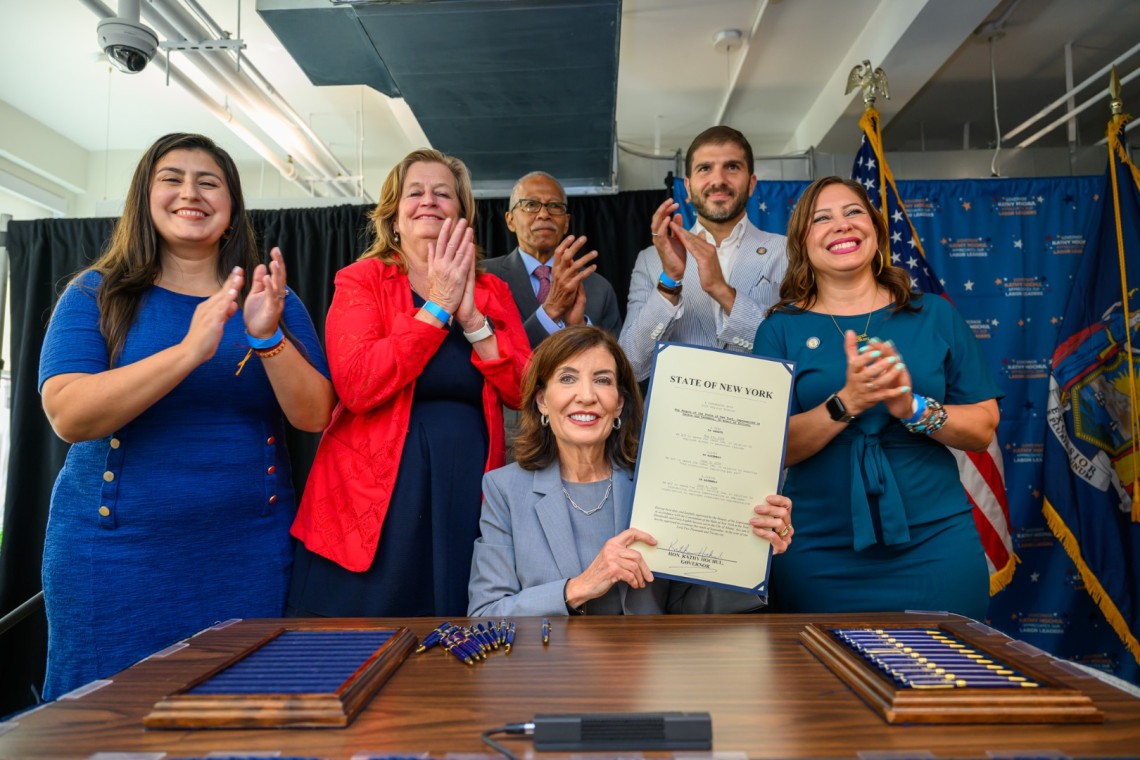
That is why I sponsored S.10605 and S.10085A to strengthen protections for World Trade Center responders whose illnesses and claims cannot be confined to an arbitrary calendar. It is why I fought for the Ignazio Giacalone Act, honoring the families of sanitation workers lost because of September 11 and its aftermath, and why we revived the September 11th Worker Protection Task Force (S8181) through 2030.
These measures differ in scope, but they share a simple principle: those who answered New York’s call should never have to fight New York for the benefits and protections they earned. Our obligation to them does not expire simply because another anniversary passes.
There is something deeply New York—and quietly powerful—in that truth: twenty-five years after Muslims were too often met with suspicion in the aftermath of September 11, two Muslim public servants are helping New York honor those we lost, protect those who answered the call, and stand with the families who still carry that day with them.
History does not always move forward in a straight line. Rights can be threatened, and old prejudices can return wearing new language. But the loudest voices of division do not have to write our future. New Yorkers have shown, again and again, that we are capable of choosing something larger than fear.
We showed it even on September 11 itself.
On that day, firefighters climbed stairwells toward danger as thousands descended toward safety. Police officers, paramedics, construction workers, nurses, transit workers, public servants, and ordinary people ran toward strangers whose names they did not know. New Yorkers lined up to give blood. Restaurants fed rescue workers. Neighbors searched for neighbors. People opened their homes, their hands, and their hearts.
In those hours, what mattered was not where someone came from, how they worshiped, whom they loved, or what politics they held. What mattered was that another human being needed help. That, too, is part of what we must carry forward.
Because memory asks more of us than ceremony. It asks whether the compassion we celebrate in retrospect is something we are willing to practice in the present—whether we can build solidarity into the ordinary architecture of our democracy, long before catastrophe reminds us that we belong to one another: in the child whose education we properly fund, the senior whose dignity we defend, the immigrant family whose rights we protect, the worker whose labor we respect, and the neighbor in crisis whom we refuse to let disappear into silence.
That is the legislative meaning of empathy: turning our concern for one another into public obligation.
Twenty-five years later, I do not want fear to have the final word. I want us to remember the hands extended through smoke and confusion, and a city wounded beyond measure that still found ways to care for itself. And I want us to summon that same instinct now—not because we agree on everything, not because our differences have disappeared, but because democracy asks us to recognize something deeper than difference: the humanity of the person standing beside us.
There will always be those who discover political opportunity in division. Our responsibility is to discover civic power in solidarity.
Let us reject the politics that teaches us to fear one another. Let us defend the rights of Muslims, Jews, Christians, immigrants, Black and Latino communities, LGBTQ+ New Yorkers, people of every faith and people of no faith—not selectively, but because dignity loses its meaning when we ration it.
Let us choose empathy without surrendering justice, peace without surrendering courage, and unity without demanding sameness.
And as we mark twenty-five years, let us hold close those who never came home and the families, friends, colleagues, and communities who have carried their absence ever since. A quarter century may measure the distance from that September morning, but it cannot measure the depth of a loss that continues across generations. To remember them is to refuse to let the passage of time make their lives smaller in our memory.
And let us teach the generation that inherited September 11 as history that the greatest memorial we can build is not made of stone.
It is the society we choose to become.
In the sections below, you will find community resources, employment opportunities, events, and updates from across our district. I hope you will read them, share what may help someone you know, and continue building with us a community where solidarity is more than something we remember from our hardest days—it is how we live through all the days that follow.
In Unity,
RJ
*Stay connected! Follow me on all social media platforms—just click the icons below!*
|